For Dr Tim Taulke-Johnson, locum work has become much more than a way to see different parts of Australia.
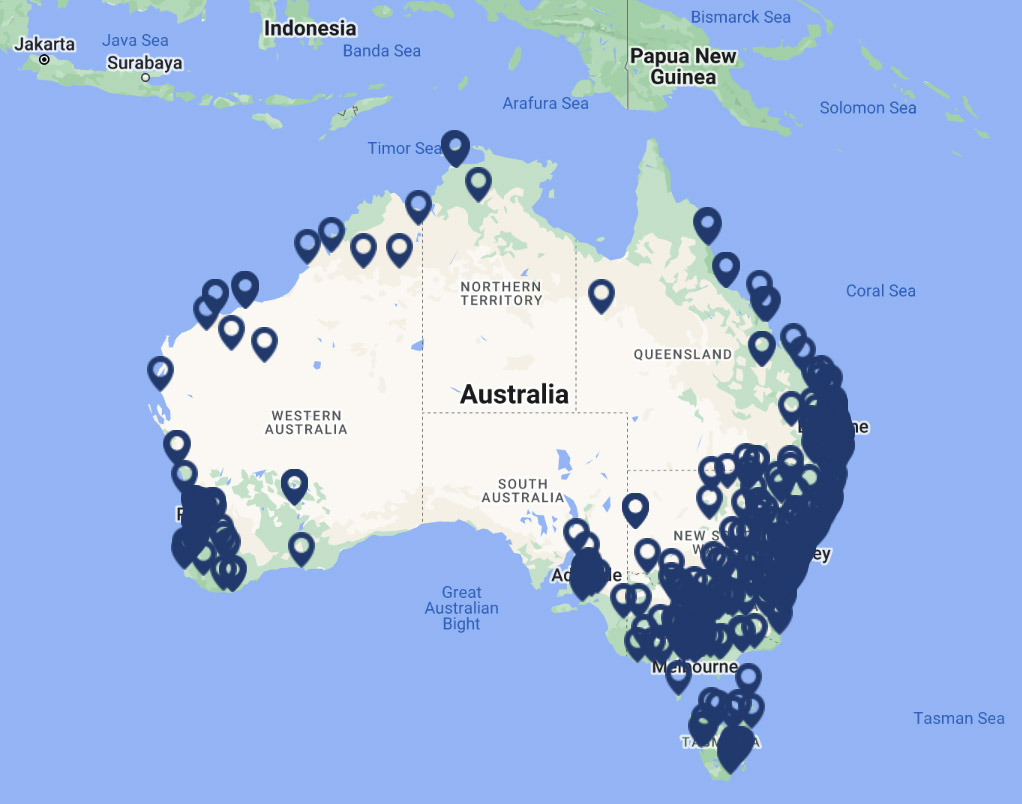
It has taken him across Western Australia, the Northern Territory, South Australia and Queensland, introduced him to communities hundreds of kilometres from their nearest major medical service, and given him the opportunity to practise medicine in environments where having a doctor available can make an enormous difference.
Now working in Newman, in Western Australia’s Pilbara region, Tim says it is rural and remote medicine that continues to bring him back.
Finding something different in medicine
Tim’s move into locum work began after returning to Australia following six years overseas in China.
He still enjoyed general practice but wanted something different.
“I thought, well, what I’ll do is travel around Australia a bit.”
That decision led to locum placements across the country, from metropolitan practices to some of Australia’s most remote communities. But it was the rural work that captured his interest.
“I’ve worked all over WA, Northern Territory, South Australia, Queensland – really mostly all over Australia. But the thing I enjoyed most was the rural areas.”
In places like Newman, patients may travel hundreds of kilometres to see a doctor. Access to services that are readily available in metropolitan areas can be limited, and that changes the role a GP plays within the community.
“You feel extremely valuable because if you’re not there, they couldn’t get a doctor.”
It is that sense of purpose that Tim finds particularly rewarding.
Medicine that keeps you thinking
Rural locum work has also allowed Tim to experience a very different side of general practice.
Rather than seeing the same types of presentations each day, he has encountered everything from rodeo and horse-riding injuries to snake bites and trauma.
“You get the real stuff out here – rodeo injuries, horse injuries, snake bites, stuff like that.”
That clinical variety has influenced Tim’s own professional development. Over the years, his interests have increasingly moved towards emergency and critical care medicine, including completing further postgraduate study.
For Tim, the opportunity to use those skills in a rural environment is part of what keeps the work interesting.
“I like the challenge, and I like being sort of independent.”
He also values the autonomy that can come with working rurally, while still having access to support when it is needed.
“We’ve got backup with telehealth, and you just feel you’re a proper doctor.”
Returning to Newman
Tim is no stranger to Newman.
He first worked there around 12 years ago in the Emergency Department and has since returned to the community as a locum.
Another placement that has stayed with him is Mornington Island in Queensland’s Gulf of Carpentaria, where working within a remote Indigenous community exposed him to medicine and experiences he simply wouldn’t have encountered in a metropolitan setting.
“You’ve got the wilderness and the desert, and it’s austere medicine. It’s very good. I like it.”
Across these communities, Tim has seen first-hand the challenges created by distance and limited access to healthcare.
For him, that is also part of the motivation to keep returning.
“The people here are just as worthy of care as in the cities.”
The moments that stay with you
Ask Tim about his most memorable experience as a rural doctor, and one particular patient from an earlier stint in Newman immediately comes to mind.
Late one night, he was called to treat a woman who had suffered a significant facial injury. With no one else available, Tim was her only option. He had to manage the injury himself, suturing the wound and controlling the bleeding, a moment that captured both the responsibility and reality of practising medicine in a remote community.
Some time later, on another visit to Newman, he spotted the same woman while walking through town.
She recognised him.
“Thank you, Doctor Tim.”
For Tim, seeing her recovered and smiling back at him became one of those moments that stayed with him long after the shift had finished.
“That was a big moment for me… she was happy.”
It is one of many experiences that have reinforced what he loves about rural medicine: being able to step in when someone genuinely needs help and seeing the impact that care can have.
A different kind of community
There is another side of rural locum work Tim values just as much: the people around him.
In smaller communities, healthcare teams often rely heavily on one another, and Tim says the team environment in Newman has been one of the highlights of his current placement.
“We all pull together. I’ve got a wonderful team with me, and we’re getting on very well, and we all help each other.”
There is also something special about returning to a rural community years later and discovering familiar faces.
After recently returning to Newman, Tim found that several doctors he had worked alongside more than a decade earlier were still coming back to work in the region.
For him, that says something about the pull of rural locum medicine.
“Once you’ve done it as a locum, you really enjoy it.”
So, what would Tim say to another GP considering locum work?
“Go for it.”
While every doctor’s circumstances are different, Tim believes the experience can offer far more than simply a change of workplace.
“If you want to enrich your life… the reward and the experience that you get from helping people…”
For doctors interested in expanding their clinical experience, seeing more of Australia and working somewhere their skills are genuinely needed, Tim believes rural locum work is well worth considering.
“If you want an uplifting, energising, enjoyable, rewarding life – that’s what I do.”
Supported along the way
Behind every successful locum placement is plenty of organisation, from travel and accommodation to contracts and ongoing support.
Tim has been working with DXC Medical Locum Recruitment Consultant Amy Sullivan and says having someone there to manage those details has made a significant difference.
“Amy’s been absolutely wonderful.”
That support became particularly important when Tim fractured his femur and unexpectedly needed time away from work.
Rather than having to worry about his placement, Tim says Amy immediately reassured him that cover would be arranged and he could concentrate on his recovery.
“Don’t you worry about it. We’ll get someone to cover your locum. Just come back when you’re ready.”
Now back in Newman and continuing his recovery, Tim remains as enthusiastic about rural medicine as ever.
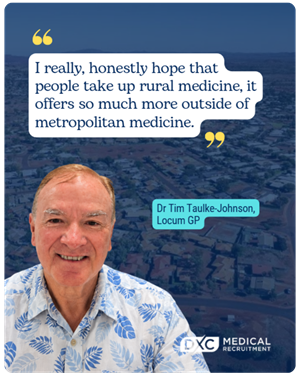
“I really, honestly hope that people take up rural medicine, it offers so much more outside of metropolitan medicine.”
After years of travelling, learning and working alongside communities across Australia and overseas, that is ultimately what Locum work has given Tim: the chance to keep practising the medicine he loves, while going where doctors are needed most.
“And it’s really, really rewarding. That’s for sure.”
To find out more and explore Locum opportunities, search our latest roles here and feel free to contact:
Amy Sullivan
Senior Consultant
National Locum GP & Rural Generalist Division
+61 416 370 196
amy.sullivan@dxcmedical.com.au